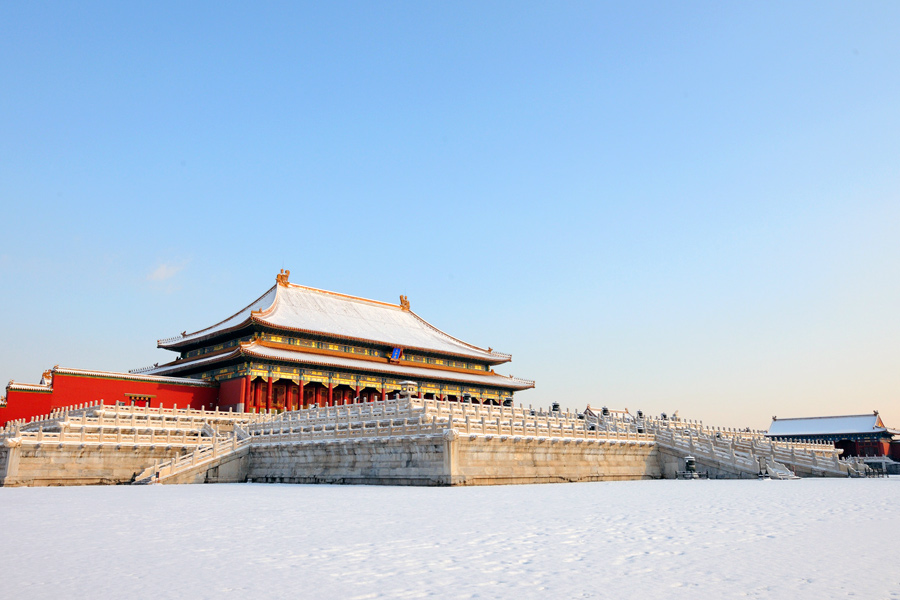
Imperial Palaces of the Ming and Qing dynasties in Beijing and Shenyang
北京和沈阳的明清皇宫
- 分类: 文化遗产
- ID: 1859128686929629185
Home CategoryCultural HeritageImperial Palaces of the Ming and Qing dynasties in Beijing and ShenyangPlay7 minsThey illustrate the grandeur of the imperial institution from the Qing Dynasty to the earlier Ming and Yuan dynasties, and Manchu traditions, and provide evidence on the evolution of this architecture in the 17th and 18th centuries.ShareRelated Videos**When China Daily meets the Forbidden City 00:00:24Splendor of Palace Museum seen in Google virtual tour 00:02:38Catalogue1. Brief Introduction2. Cultural Heritage3. Architecture4. Art TreasuresCategory of Site: Cultural Site
Brief Introduction
The Forbidden City, located in the center of Beijing, served as the imperial palace for the Ming and Qing dynasties. Construction began in 1406 and was completed in 1420. The rectangular palace covers approximately 720,000 square meters, measuring 961 meters in length and 760 meters in width. It is said that the Forbidden City contains a total of 9,999.5 room spaces (an area enclosed by four poles). In 1924, the last imperial family of the Qing Dynasty was removed from the Forbidden City, and in 1925, the Palace Museum was established.
The Forbidden City has four entrance gates: the main Meridian Gate (Wumen) to the south, the Eastern Flower Gate (Donghuamen), the Western Flower Gate (Xihuamen), and the Gate of Divine Prowess (Shenwumen) to the north. The palace grouns are divided into two parts: the Outer Court (Qianchao) to the south and the Inner Court (Neiting) to the north. The Outer Court includes three main halls: the Hall of Supreme Harmony (Taihedian), the Hall of Central Harmony (Zhonghedian), and the Hall of Preserving Harmony (Baohedian). The Inner Court includes the Palace of Heavenly Purity (Qianqinggong), the Hall of Union and Peace (Jiaotaidian), and the Palace of Earthly Tranquility (Kunninggong).
Built in 1625, the Shenyang Imperial Palace, which is nearly 400 years old, is one of the few historic sites in China that epitomize ethnic minority culture.
The Shenyang Imperial Palace follows traditional Chinese palace construction methods and incorporates typical features of traditional Manchu residences, integrating the architectural styles of Han, Manchu, and Mongolian cultures. The layout is based on the "eight-banner system," a unique social organization system in Manchu society.
The Forbidden City in Beijing was added to the UNESCO World Heritage List in 1987. In 2004, the Shenyang Imperial Palace was included as an extension to the original listing.
Cultural Heritage
The imperial palaces represent masterpieces in the development of imperial palace architecture in China.
The architecture of these palace complexes, especially in Shenyang, reflects significant influences from traditional Chinese architecture, particularly during the 17th and 18th centuries.
The palaces provide exceptional evidence of Chinese civilization during the Ming and Qing dynasties. They preserve landscapes, architecture, furnishings, and art objects, showcasing the living traditions and customs of Shamanism practiced by the Manchu people for centuries.
The palaces exemplify the grandeur of the imperial institution from the Qing Dynasty to the earlier Ming and Yuan dynasties, and they provide evidence of the evolution of this architecture in the 17th and 18th centuries.
Architecture
The Forbidden City is surrounded by a 10-meter-high wall and a 52-meter-wide moat. It has four entrance gates: the main Meridian Gate (Wumen) to the south, the Eastern Flower Gate (Donghuamen), the Western Flower Gate (Xihuamen), and the Gate of Divine Prowess (Shenwumen) to the north. To reach the Palace of Heavenly Purity (Qianqing Palace), the emperor's living quarters, one must pass through seven gates: Zhengyangmen, Damingmen, Tiananmen, Duanmen, Wumen, Taihemen, and Qianqingmen.
The palace grounds are divided into two parts: the Outer Court (Qianchao) to the south and the Inner Court (Neiting) to the north. The Outer Court consists mainly of three halls: the Hall of Supreme Harmony (Taihedian), the Hall of Central Harmony (Zhonghedian), and the Hall of Preserving Harmony (Baohedian), where important ceremonies were held. On each side of these halls are the Hall of Literary Glory (Wenhuadian) and the Imperial Library (Wenyuange) on the east, and the Hall of Military Prowess (Wuyingdian) on the west.
The Inner Court includes the Palace of Heavenly Purity (Qianqing Palace), the Hall of Union and Peace (Jiaotaidian), and the Palace of Earthly Tranquility (Kunning Palace), where emperors and empresses lived. Behind them is the Imperial Garden. On each side of the inner three great halls are six eastern palaces and six western palaces, used as residences for concubines. The six eastern palaces are Jingren Palace, Yanxi Palace, Chengqian Palace, Yonghe Palace, Zhongcui Palace, and Jingyang Palace. The six western palaces are Yongshou Palace, Taiji Hall, Yikun Palace, Changchun Palace, Chuxiu Palace, and Xianfu Palace.
There are Buddhist sanctuaries to the east of the six eastern palaces and to the west of the six western palaces. Besides the inner and outer courts, there are two major building compounds: the Outer Eastern Road (Waidonglu) and the Outer Western Road (Waixilu). To the south of the Outer Eastern Road are the Southern Three Halls (Nansansuo), residences for princes. To the north are the Hall of Supreme Royalty (Huangjidian) and the Hall of Peaceful Longevity (Ningshou Palace). Further north are the Hall of Mental Cultivation (Yangxidian), the Hall of Happiness and Longevity (Leshoutang), the Hall of Harmony (Yihexuan), and the Garden of the Hall of Peaceful Longevity. To the south of the Outer Western Road is the Hall of Peaceful Benignity (Cining Palace), and to its north are some Buddhist sanctuaries.
The Shenyang Imperial Palace covers 70,000 square meters with about 300 rooms in 70 buildings. Though smaller than Beijing's Forbidden City, it has unique features and significant historical, artistic, and scientific value.
The Dazheng (Grand Politics) Hall, founded by Nurhaci, has a group of 10 Banner Pavilions in front that were administrative offices for tribal chieftains. The buildings are in typical Manchu style and display the "eight-banner system" that originated in the Manchu tribes' hunting process.
Art Treasures
The Palace Museum is one of the largest museums in China, housing about one million valuable artworks, most of which belonged to the imperial families of the Ming and Qing dynasties.
These art treasures include paintings, pottery, bronze wares, gold and silver wares, embroidery, sculptures, inscribed wares, jade wares, lacquer wares, and lacquer enamel wares. Additionally, there are court articles, including jewels, accessories, clocks, medicines, furniture, and furnishings. It is a unique and superb building complex, integrating the outstanding achievements of ancient Chinese architecture. In 1961, the Forbidden City was included in the List of Key Historical Monuments under State Protection. Article reference1. Imperial Palaces of the Ming and Qing dynasties in Beijing and Shenyang. chinadaily.com.cn. 2018Photo Gallery(23 pictures)CategoriesCultural HeritageTagWorld Heritage in ChinaTangible Cultural HeritageArchitectureCatalogue1. Brief Introduction2. Cultural Heritage3. Architecture4. Art Treasures- - - []
来源: Culturepedia - Imperial Palaces of the Ming and Qing dynasties in Beijing and Shenyang








